
For campuses and companies
Cover a population,
not a person.
A safety app only works if the person who needs it already has it. Issuing 3rd-i centrally to a student body or a workforce is how you stop that being a coincidence.
Two kinds of buyer
Same product, different population.
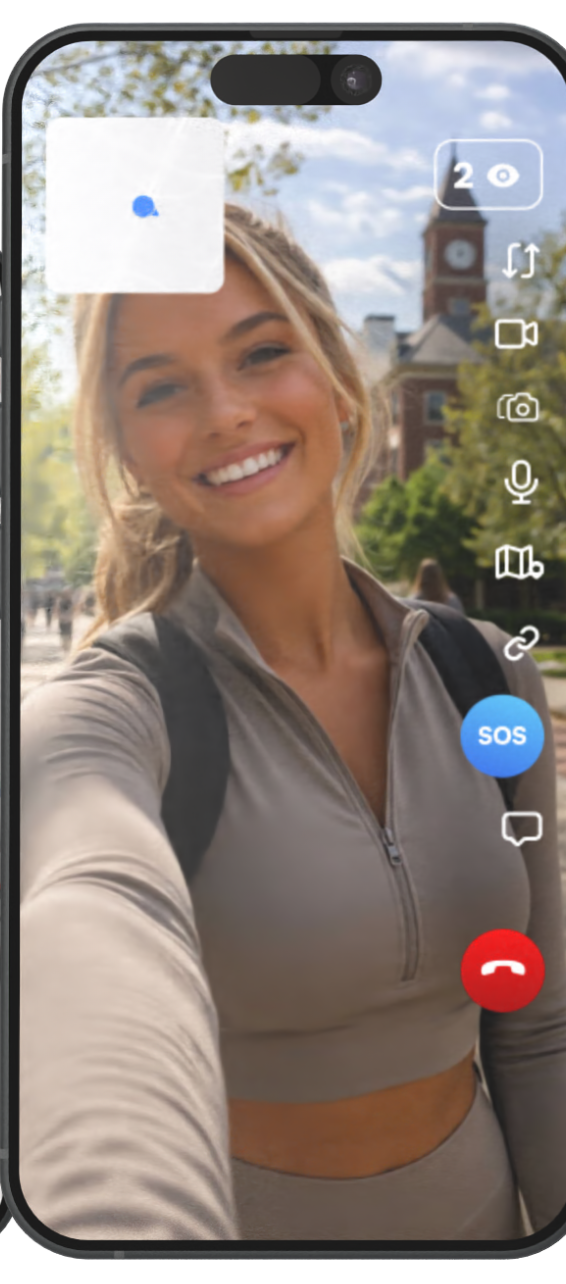
Universities
The walk back across campus.
Students walk home late, take rideshares alone, and work in labs and libraries at hours when the campus is empty. A blue light phone only helps if you are standing next to it. 3rd-i travels with them.
- Seats issued to enrolled students, no individual sign up
- Works off campus, which is where most of the walk actually happens
- Squads students pick themselves, so they will actually use it
- Safety Agent monitoring and 911 escalation on every seat
Employers
The people who finish after dark.
Night shifts, lone working, home visits, field techs, hospitality staff closing up, anyone who travels for work. Duty of care is a policy until somebody can actually see what is happening.
- Cover a whole shift pattern or one exposed team
- Live video and location, not a check in box that gets ticked late
- Alarms reach a Safety Agent, not an unstaffed inbox
- One agreement and one bill instead of expense claims
Where this came from
It started on a campus.
Dillon Abend founded 3rd-i after facing real danger on late night runs in bear country in New Jersey. He had been calling friends just to have somebody on the line, which is the entire product in one habit.
The idea matured at the University of Miami, with an early focus on rideshare safety. The company is still built around the same question a student asks at 1am: does anybody actually know where I am right now.
That is why the campus case is not a repackaging exercise for 3rd-i. It is the case the product was designed against first.
3rd-i in the press

What you are buying
Seats, minutes, and a real person at the end of the alarm.
The app your people install is the same one on the App Store. What an agreement changes is who pays, who is covered, and how the minutes are pooled.
Seats issued centrally
Your population gets covered without anyone having to find the app, pick a tier and put a safety subscription on a personal card.
Pooled streaming minutes
Minutes sit in one pool across the deployment, so the people having a bad month are covered by the people who are not.
Safety Agent monitoring
Every seat carries the same escalation path as a paid consumer plan: a Safety Agent on the stream, and 911 when it needs to go further.
Privacy that survives scrutiny
You are buying cover, not surveillance. A trip only exists while the person starts one, and nobody, including you, can start one for them.
Their circle, not your org chart
People choose the squad that watches their trips. Adoption follows from that, because they are sharing with friends rather than reporting to an institution.
One agreement, one bill
Per seat pricing against the size of your population, on a single invoice, instead of reimbursing individual subscriptions.
Placeholder Per seat pricing is set with 3rd-i against the size of the deployment. No enterprise price is published on this page because none has been agreed.
The question your counsel will ask
You are paying for it. You still cannot watch them.
This is the difference between safety cover and monitoring, and it is the reason a deployment gets adopted instead of quietly uninstalled.
What a deployment gives you
- Every person in your population covered, whether or not they would have paid
- A real escalation path with a Safety Agent and 911 behind it
- Aggregate usage against the seats you are paying for
- A duty of care answer that works off site and after hours
What it does not give you
- No ability to see where any individual is
- No ability to start a trip on somebody's behalf
- No location, route or video between trips, for anyone
- No feed of who went where, because that record belongs to them
Talk to us
Tell us how many people you need to cover.
Population size is the only number we need to come back with a real answer.
3rd-i for organisations
Nobody should have to buy their own safety net.
If your people are walking home late, working alone, or travelling for you, cover them properly and let them pick who watches.